
Blog
Blog
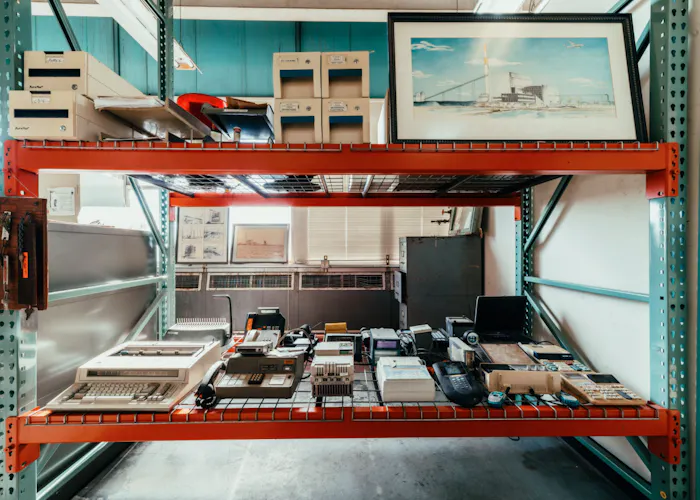
Photo: Peter Mendelson
Taught by professor Courtney Fullilove in the Fall of 2025, Energy Legacies and Ecological Futures explored how energy infrastructure impacts the natural and built environment. Using Manresa Island as a primary case study, students conducted oral histories and analyzed historical records of how Manresa Island was used and inhabited across the centuries.
After a research visit to the Norwalk History Room at the Norwalk Public Library and the artifact room in the power plant, each student picked a document or object to discuss and analyze in depth. Sources ranged from news clippings discussing the city's decision to allow for the construction of a power plant, to heat stress and vibration monitoring equipment, to old aerial photos of the site.
Highlighted below are specific artifacts discussed by Energy Legacies students.
Published in the New York Times on October 3rd of 1956, this article reported on governmental approval for the construction of a power plant on Manresa Island. While at a glance appearing to be a simple bureaucratic update, this article shows much more about the general perspective on energy infrastructure and environmentalism in the mid 20th century.
Odin Fawer observed that, in the mid-1950s, environmentalism had not yet emerged as a consolidated political movement: “reporters rarely spoke about pollution, wildlife, or the living conditions of people who lived near large industrial sites.” Instead, concerns about cost and efficiency dominated. “Early resistance to the plant demonstrated that some people were starting to think differently about their surroundings,” Odin noted, “but without legal protections and a strong environmental movement, residents of the greater Norwalk area had very little clout.”
This brief article shows us how perspectives on energy, environment, and government have shifted over time. Concerns that journalists overlooked in 1956 now anchor debates over energy infrastructure. Despite these shifts, environmental problems persist, and serious action remains necessary to protect people and ecosystems alike.”

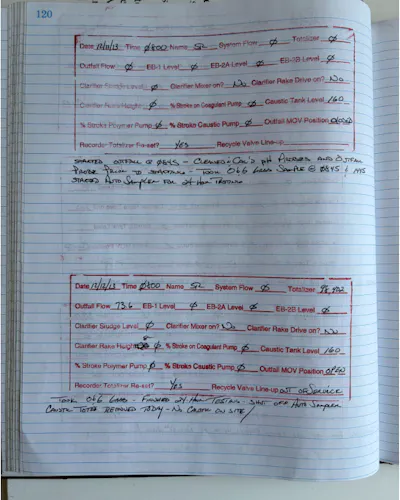
Located in the archive room at the power plant, this logbook provides a detailed record of the wastewater treatment plant’s operations between 2011 and 2013. While mostly a standardized report on different machinery, the book also includes comments that give a unique perspective about major events during the station’s operation. A note from October 29th 2012 reads: “Hurricane Sandy coming ashore.” In a discussion of the logs, student Atharv Dimri wrote “Then, on October 31, the comments read ‘Preset totalizer to zero outfall registered 36 gallons from Hurrican [sic] flooding– never outfalled, system was shut down…’ A totalizer is simply a tool that measures how much water flows through a specific area. In this case, we can see that 36 gallons of water flowed through an area, (probably the storm drainage system) because of Hurricane Sandy.” The lack of prior comment prior gives the impression of the hurricane’s sudden surge.
At the time Sandy came ashore, the station was operating as a “peaker plant” and already slated for decommission. The cessation of operations in the year following Sandy is evident in this book. The stamp goes from black to red and the initials of the person managing the log switch from DW to SR, implying a potential change in roles. When flipping through the latter half of the book, the symbol ∅ (null) becomes increasingly more common. This mark shows the infrastructure being shut down piece by piece. These logs provide insight into the impacts of Sandy on Manresa and the process of decommissioning and terminating operations from the vantage of the wastewater treatment plant.
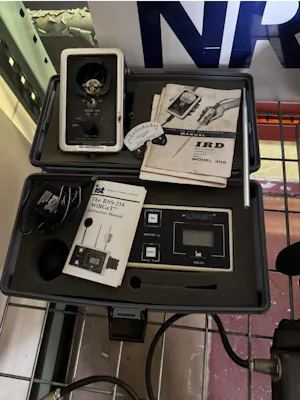
These two devices, preserved in the Manresa artifact room, provide a unique insight into work safety at the power plant. The RSS-214 “WiBGeT” was used to protect workers from overheating, while the IRD Self-Powered Portable Vibration Meter Model 306 monitored vibration levels of machinery to prevent mechanical failures. Both were instrumental in keeping the plant safe.
The WiBGeT is a heat stress monitoring device that functions by measuring different parts of the atmosphere. In his discussion of the tool, student Conor Humowiecki wrote, “The RSS-214 WiBGeT measured three different variables: dry bulb, wet bulb, and globe temperature. Dry bulb is the temperature of the air. The wet bulb measures how [well] the body is able to cool itself with sweat. The globe temperature measures the radiant heat from hot machinery on the human body by using a temperature-sensing bulb inside a hollow copper sphere that is painted black to mimic how the human body absorbs heat. Together, these temperatures create the Wet Bulb Globe Temperature index, which is the standard for predicting heat stress risk.” The device is extremely accurate with a margin of error of ±.4℃. For context on the extreme temperatures workers faced, check out this clip from an interview with former plant manager Bob Gunderson.
While the WiBGeT’s measured heat, the IRD Self-Powered Portable Vibration Meter Mode 306 sensed motion. It protected the plant by making sure machinery was running correctly. Humowiecki explained, “[The IRD 306] uses a detachable velocity sensor to measure vibration levels as displacement or velocity. The sensor can measure between 5 Hz to 2,500 Hz, which allows operators to detect issues in the machinery, including imbalance, looseness, or bearing wear. These problems, if left untreated, could lead to complete mechanical failure and workplace injuries.” The introduction of the IRD 306 allowed for safer working conditions, as people were no longer tasked with guessing the health of the machinery.
Both the WiBGeT and IRD 306 give a look into working conditions in the power plant and how they changed over time. While improving safety, they also highlight the intense heat and potential danger that workers experienced.
Interested in seeing the logbook or these machines for yourself? Sign up for a tour of the power plant here and learn more about the history of Manresa Island!
Published 6.17.26